
Shining Light on California Dairy’s Environmental Leadership and the Urgent Need to Address Water Scarcity
Creating more efficient and resilient food systems reduces global climate impacts while better ensuring food and nutrition security. California agriculture is a world leader in this area and remains a steadfast partner in global efforts to advance sustainable practices. The state’s draft strategy for agriculture resilience demonstrates tremendous progress, a multipronged approach to improve climate preparedness, and a critical need to address water scarcity.

These same themes were shared by members of the California dairy sector at the national Sustainable Ag Summit, held in Anaheim this year. Through several panel discussions and presentations at this conference and the adjoined national Dairy Sustainability Alliance meeting, dairy leaders highlighted success and ongoing challenges.
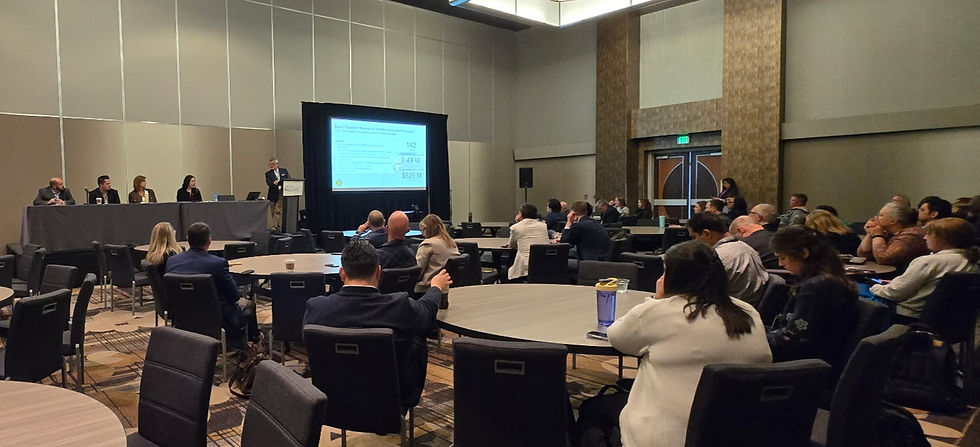
In just the past few years, California’s dairy farmers have achieved world-leading reductions of methane emissions and have helped ensure access to clean drinking water in rural communities, while making ongoing improvements to water conservation and protection. The dairy sector continues to work in partnership with local, state, and federal agencies on these important endeavors.
California’s dairy farmers remain resilient, producing more milk with fewer cows, while investing in new technologies to further protect natural resources. However, increasingly scarce water supplies pose a serious threat to the economic and environmental sustainability of California’s farms.
Water availability is one of the most daunting challenges facing California agriculture. Geoffrey Vanden Heuvel, Director of Regulatory and Economic Affairs for Milk Producers Council and the Vice Chair of the Water Blueprint of the San Joaquin Valley provided a keynote on this topic. He provided historical context, explaining how abundant farms and vibrant communities developed as the state and federal government made significant investments in complex water projects, capturing and moving water across the state, allowing for the creation of the world’s most plentiful agricultural production region and the growth of the nation’s most populated state. However, he explained, the current water infrastructure system can no longer meet the state’s needs.
While infrastructure has aged, the need to capture and convey water has grown due to changing climate patterns and the depletion of groundwater resources. As the state restricts pumping via the Sustainable Groundwater Management (SGMA), agricultural production land is being fallowed. While helpful solutions are on the horizon, a shrinking of the state’s agricultural footprint is inevitable. With enactment of SB 72 this year, California will soon have a sustainable strategy for ensuring reliable water. However, developing and carrying out plans to achieve the targets remains a colossal task.

While California’s dairy farmers have a long history of advancing water-smart practices, addressing the water scarcity outlook is not something they can manage alone. They continue to partner with engineers, researchers, and government agencies to verify the most water-efficient practices and identify new opportunities for future investments. However, as SGMA implementation progresses, growing or acquiring high-quality feed for dairy cows becomes increasingly challenging. Investing in strategies to grow more ‘crop per drop’ is important but doesn’t provide relief to farmers who are reliant on groundwater, given that SGMA restrictions measure water use via crop evapotranspiration. Creating greater availability of surface water will be essential to limiting the loss of agricultural production.

As California leads the way for efficient and sustainable farming practices, preserving California agriculture has local and global implications. California’s dairy sector alone is the largest in the nation, producing about 18 percent of U.S. milk and generating a total direct, indirect, and induced economic output of around $87.5 billion. Dairy farms are a key economic driver that work in harmony with other facets of California’s diverse agricultural and environmental ecosystems—utilizing byproducts as animal feed, recycling manure nutrients for use as organic fertilizer, and providing biodiverse ecosystems that have been essential to protecting the threatened tricolored blackbird species.
As the state’s resiliency strategy points out, California agriculture not only depends on a secure water supply but can also play an important role in supporting the sustainability of that water supply and the long-term sustainability of communities, farms, and ecosystems alike. Through efforts like the Water Blueprint for the San Joaquin Valley, the agricultural community will continue to work alongside community leaders, water agencies, local governments and others to advance common-sense water solutions.
California dairy’s sustainability success stories to date all involve teamwork. Advancements have been made through collaboration with local, state, and federal partners, university researchers, technology providers, NGOs, companies within the dairy supply chain, and others. The need for continued collaboration is stronger than ever. Progress happens faster when parties move forward together. This critical conversation about water supply will be a part of the sixth California Dairy Sustainability Summit, to take place on March 24, 2026, at the Visalia Convention Center.
A more reliable water supply ensures a more vibrant and resilient future for all.
California’s dairy farmers are committed to doing their part to achieve this vision.


Has anyone else noticed standing water or a persistent smell and wondered if the basement drain was the real problem? I found a useful checklist at https://drainexpress.ca/what-to-do-when-your-basement-drain-is-clogged-with-dirt-or-mud/. Signs listed include water that won’t drain on the floor, bad odors throughout the house, fluctuating water levels when flushing, and gurgling toilets or slow shower drains. The piece stresses acting early so a simple clog doesn’t turn into a larger backup. Helpful if you’re trying to connect symptoms upstairs with what’s happening under the house.
Greetings everyone. Fixed-power readers worked for a book but left the phone and a menu slightly off, so I started looking into progressive reading glasses. The guide at https://optyx.com/understanding-what-progressive-reading-glasses-are-and-their-benefits/ explains that progressive readers shift magnification smoothly from top to bottom with no visible line, unlike bifocals. It also separates non-prescription progressive readers from full prescription progressive lenses that correct near, intermediate, and distance vision. Practical if you only struggle up close but want more flexibility than a single strength.